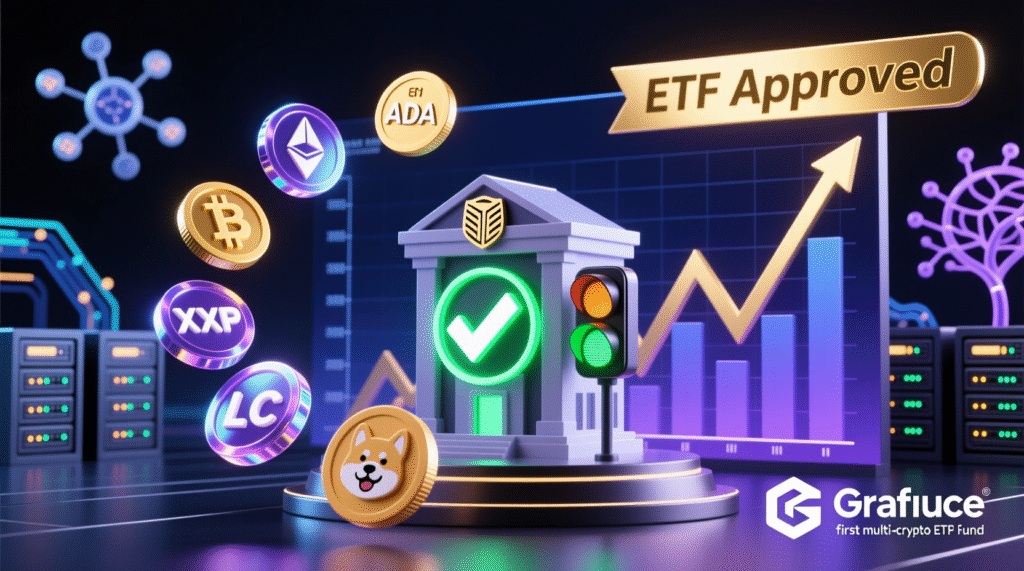
On Wednesday, the U.S. Securities and Exchange Commission (SEC) approved uniform listing standards for spot cryptocurrency exchange-traded funds (ETFs). This decision simplifies the process for launching new crypto ETFs by eliminating the need for individual approval under Rule 19b-4. As a result, the market could see a wave of new digital asset ETFs in the coming weeks.
Grayscale launches first multi-cryptocurrency fund in the US
Grayscale has received approval to launch its Digital Large Cap Fund (trading under the ticker GDLC) under new standards. It is the first diversified crypto ETF in the US, encompassing multiple assets: Bitcoin (BTC), Ethereum (ETH), XRP, Solana (SOL), and Cardano (ADA). Grayscale CEO Peter Mintzberg emphasized that the team is committed to bringing the product to market as quickly as possible.
Which altcoins can be included in an ETF?
According to Bloomberg analyst Eric Balchunas, approximately 12–15 cryptocurrencies could qualify for inclusion in spot ETFs. However, a key requirement is the availability of regulated futures contracts on the Coinbase Derivatives exchange, which must be traded for at least six months.
For example, Solana futures were launched in February 2024, meaning that SOL officially complies with SEC requirements as of August 19. This paves the way for the creation of a spot ETF for this asset. Similar prospects are being considered for other tokens, such as Dogecoin (DOGE), Litecoin (LTC), and Chainlink (LINK).
Confirmed interest from the industry
Crypto community representatives are already noting growing interest in altcoin ETFs. Zach Raines of the Chainlink ecosystem reported that applications for LINK ETFs have already been submitted by Bitwise and Grayscale. The Litecoin Foundation also stated that the new rules create the necessary regulatory framework for LTC listing in the US.
Hedera (HBAR) is also attracting investor attention. According to several analysts, including investor Mark, the HBAR token may soon receive its own ETF.
What does this mean for the market?
The approval of common listing standards marks an important step toward institutionalizing the crypto market. This not only expands investment opportunities for retail and institutional investors but also makes access to crypto assets simpler and more regulated—without the need to directly own digital assets.
ETF analyst James Seyffarth quipped, “The race is on in just a few weeks.”