Key Takeaways
- In 2024–2025, fraudulent schemes masquerading as airdrops from popular projects — such as Hamster Kombat, Wall Street Pepe, and others — led to multimillion-dollar losses. According to Chainalysis, total damage from crypto scams in 2024 exceeded $9.9 billion.
- Fake airdrops imitate official campaigns to trick users into revealing private keys, signing malicious smart contracts, or transferring prepayment to “unlock” tokens — all leading to irreversible theft of assets.
- Among the main signs of fraud are: absence of official announcements, suspicious URLs, requests for secret phrases, crude errors in text, and inflated reward promises.
- The future of airdrops lies in activity-based models: retroactive rewards, AI analysis of user behavior, and incentivizing real contributions to the ecosystem, rather than simple button clicks.
What is a Fake Airdrop?
An airdrop is a common practice of free token distribution aimed at attracting attention, expanding the community, or stimulating dApp usage. Typically, participation only requires connecting a wallet, following social media, or completing a simple task.
However, this very simplicity makes airdrops an attractive target for scammers. Under the guise of generous distributions, they:
- create fake websites and social media accounts,
- demand entry of secret phrases or private keys,
- request payment for “gas fees” or “withdrawal tax”,
- encourage signing dangerous transactions that grant full access to wallets.
In 2023, just one phishing tool — Inferno Drainer — helped criminals steal over $80 million using ready-made fake airdrop templates.
10 Signs of a Fake Airdrop
- No Official Announcement
If the distribution is not announced on the official website, verified X account, or Discord/Telegram channel of the project — it’s almost certainly a scam. Fraudsters often send invitations through spam messages or fake groups. - Requesting Private Key or Seed Phrase
Legitimate projects never request this data. Any request to “confirm wallet ownership” through entering a secret phrase is 100% fraud. - Payment Required to Receive “Free” Tokens
Legitimate airdrops don’t require payment. If you’re asked to transfer ETH, USDT, or any other cryptocurrency — it’s a trap. - Suspicious URL or Clone Website
Phishing sites often look almost like the original but contain typos, unusual domains (.com.co instead of .com), or random characters. Always verify the address manually. - Crude Errors and Aggressive Marketing
Phrases like “Last chance!”, “Today only!”, “Get $5000 with 1 click!” are signs of low-quality scams. Real projects write professionally and without creating panic. - Fake Comments and Bots on Social Media
Mass reviews like “I already received mine!” are often left by bots. Don’t trust artificial “hype” — verify information through independent sources (Reddit, CoinGecko, DeFiLlama). - Unknown Token Without Whitepaper and Team
If a project has no technical documentation, roadmap, official website, or public team — it’s a red flag. Participating in such distributions is extremely risky. - Token Approval Traps
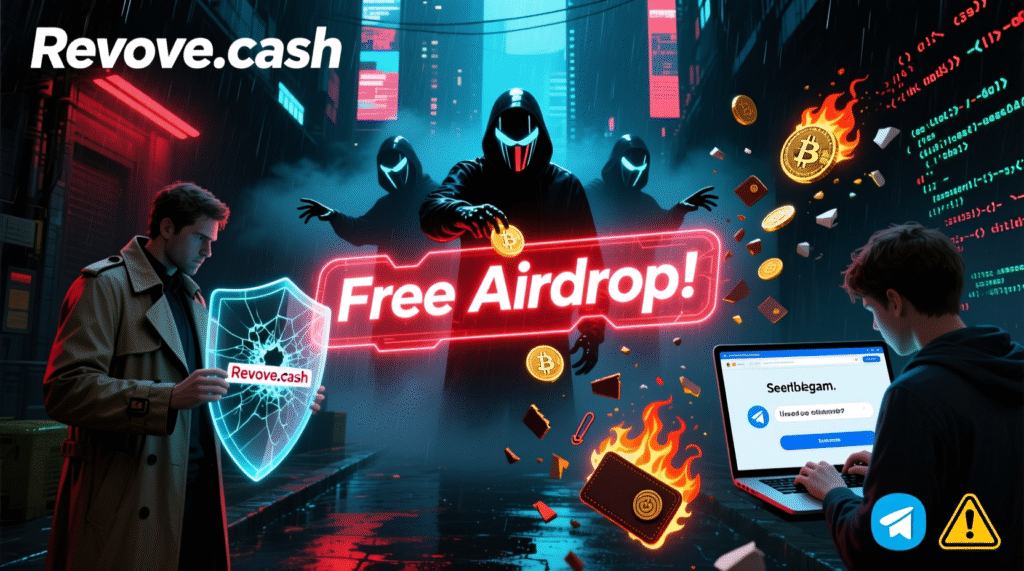
By connecting your wallet to a suspicious site, you may accidentally grant permission to withdraw all your tokens. Always check what permissions the smart contract requests, and regularly revoke unnecessary approvals through services like Revoke.cash. - Wallet Drainer Sites
Such pages imitate airdrop application forms but launch malicious transactions upon wallet connection. Always carefully read transaction data before confirming. - Unrealistic Promises
“Get $2000 in 10 seconds!” — if an offer seems too good to be true, it definitely isn’t real. Genuine airdrops give modest rewards for real actions.
Real Examples of Fraudulent Airdrops
- Hamster Kombat: popular Telegram game with HMSTR token. Scammers created fake sites promising free tokens to steal wallet data.
- Wall Street Pepe ($WEPE): fake airdrop mimicked the official website and forced users to sign contracts leading to complete loss of funds.
- HEX: phishing copy of the HEX site automatically activated a malicious contract upon wallet connection.
- Sui (SUI): victims checking airdrop eligibility lost all assets due to automatic transfers to scammer addresses.
- LayerZero: scammers used fake X accounts to direct users to a clone site and steal their cryptocurrency.
How Airdrops Are Evolving: From Chaos to Accountability
Modern projects are moving away from mass distributions in favor of targeted rewards:
- Retroactive airdrops: rewards for past activity (e.g., using a dApp before token announcement).
- AI behavior analysis: identifying bots and fake wallets.
- Transparent criteria: only those who genuinely contributed receive tokens.
Such approaches make airdrops not just a marketing tool, but a mechanism for fair distribution of power and value in decentralized ecosystems.