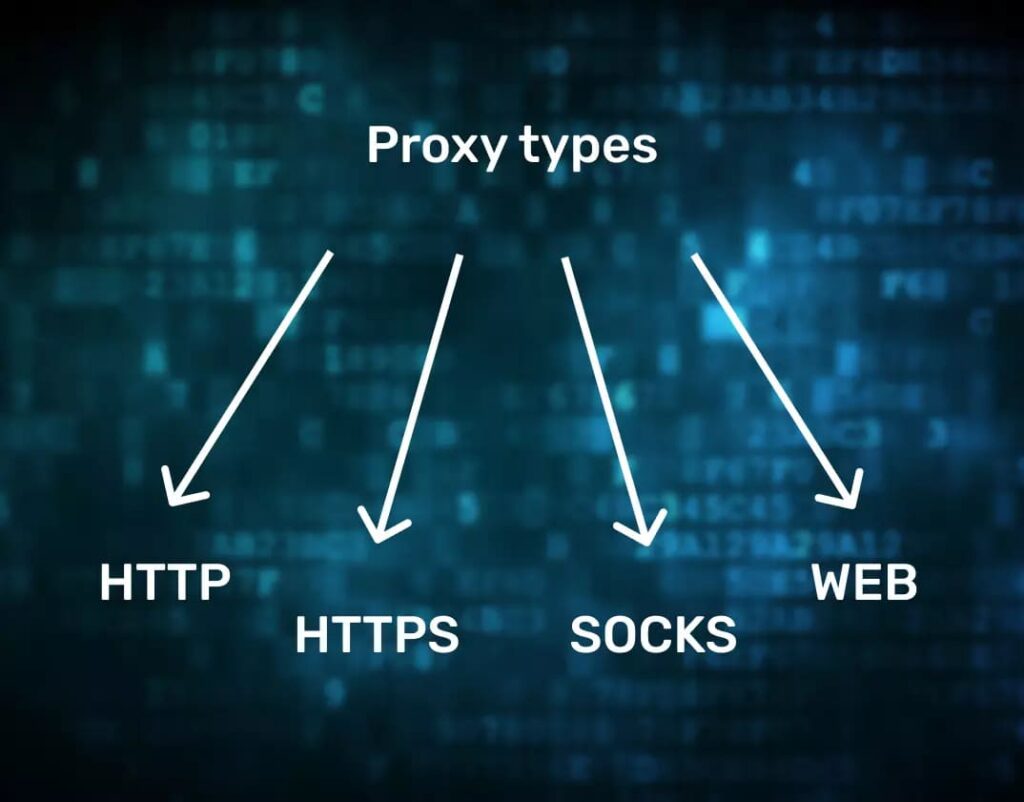
Let’s explore what exactly is meant by the terms “residential,” “mobile,” “ISP,” and “data center” proxies, their technical differences, and how routing and authorization are implemented.
What does a proxy do anyway and why does a developer need it?
Imagine you’re testing a new web app in the US, while your DevOps team is based in Europe. You’re running automated geolocation tests, validating ads, simulating mobile client behavior… But all your traffic is coming from the same IP addresses. Bots on Google, TikTok, Amazon, and Facebook see this—and they trigger a ban, a captcha, or a silent block.
A proxy server is more than just a way to change your IP address. It’s a router, a filter, a session controller, and sometimes a CDN bypasser and anti-bot. Let’s take this step by step.
Datacenter proxies
What are they:
IP addresses leased from hosting providers (OVH, Hetzner, DigitalOcean). They are hosted on a VPS/server and disguised as regular traffic.
How they work:
- NAT → public IP access
- Protocols: SOCKS5, HTTP(S)
- Multithreading support, RPS > 5000 without problems
Cons:
- Easily detected by ASN
- Often blocked if overloaded
- Not suitable for complex purposes such as bypassing TikTok, Google Ads, Meta
Pros:
- Cheap
- Ultra-fast
- Great for non-blocking tasks (like scraping RSS, PDF, files, images)
Residential proxies
What it is:
Routing a request through a real person’s device: a router, a PC, or a mobile phone with an SDK. The owner is connected to the internet through a home provider.
- ASN and PTR point to the actual ISP
- Hard to detect: looks like a regular user
- You get access to an IP pool, not just one IP.
- Sessions can be sticky (up to 30 min) or rotating (change every N sec)
- The proxy is issued through a gateway (for example,
us.proxyempire.io:5000), the IP is substituted dynamically
Pros:
- Excellent cross-country ability on anti-bots (Cloudflare, DataDome)
- Allows you to emulate the behavior of a real user
- It’s hard to ban
Cons:
- Higher latency
Mobile proxies (4G/LTE)
What it is:
IP addresses obtained from mobile operators – usually via SIM cards in USB modems or mobile devices.
- Looks like a “real person on the phone”
- Often used to bypass anti-bots on TikTok, Instagram, and Google Ads.
- Traffic goes through the mobile operator’s NAT – one IP can have multiple clients
- IP is changed either programmatically (via AT command) or by timer
Pros:
- Almost impossible to distinguish from a real user
- Excellent passability (including through anti-spam filters)
Cons:
- Dear ones
- Limited parallelism
ISP proxies (static from providers)
What is this:
IP addresses issued by a real provider (ASNs from telecom registries), but assigned to a server in a data center. In other words, a hybrid.
- Suitable for payment systems, Google Business, and advertising accounts
- Maintain constant IP (static login)
- Work through a tunnel (VPN, GRE, WireGuard)
Pros:
- Staticity
- Trust from CDN
- It’s easy to whitelist through a firewall.
Cons:
- A bit expensive
When to use which type
| Task | Proxy type |
|---|---|
| Marketplace scraping | Residential |
| Farming TikTok accounts | Mobile |
| Price Monitoring / SEO | Datacenter or ISP |
| Launching advertising in Google Ads | ISP / Mobile |
| Website localization testing | Residential / ISP |
| Login as a real user | Mobile |
It’s important to understand that modern, high-quality providers don’t sell IP addresses individually . Clients gain access to a full IP pool, paying by traffic , not by the number of addresses. This allows for the use of thousands of unique IP addresses within a single connection. Connection example:
GET http://user:pass@res.proxyempire.io:5000/?country=US&sticky_session=trueHere you connect to a residential proxy with an IP from the US and the sticky session option—the IP is saved across multiple requests in a row, which is critical when working with cookie/session-based sites.
If your traffic volume exceeds 1 TB/month, it makes sense to contact the provider directly. Some companies, including ProxyEmpire, Decodo, SOAX, and NetNut, offer customized terms and significant discounts for such clients.
When choosing a proxy provider, consider not only its technical specifications but also its activity in the professional community. Companies that participate in industry conferences tend to be more transparent, keep up with trends, and are open to dialogue with developers. This may be an indirect, but important indicator of their reliability and technological advancement.