This is a common misconception, but in reality, it’s extremely oversimplified. Get ready for a surprise: multi-accounting technologies are actively used in legitimate businesses—and literally everywhere.
Interested? In this article, we’ll take a detailed look at the most popular commercial use cases for anti-detection browsers. Some are obvious—for example, managing multiple social media accounts—while others seem more mysterious, especially to beginners.
If you want to understand or just get acquainted with the topic, you’ve come to the right place.
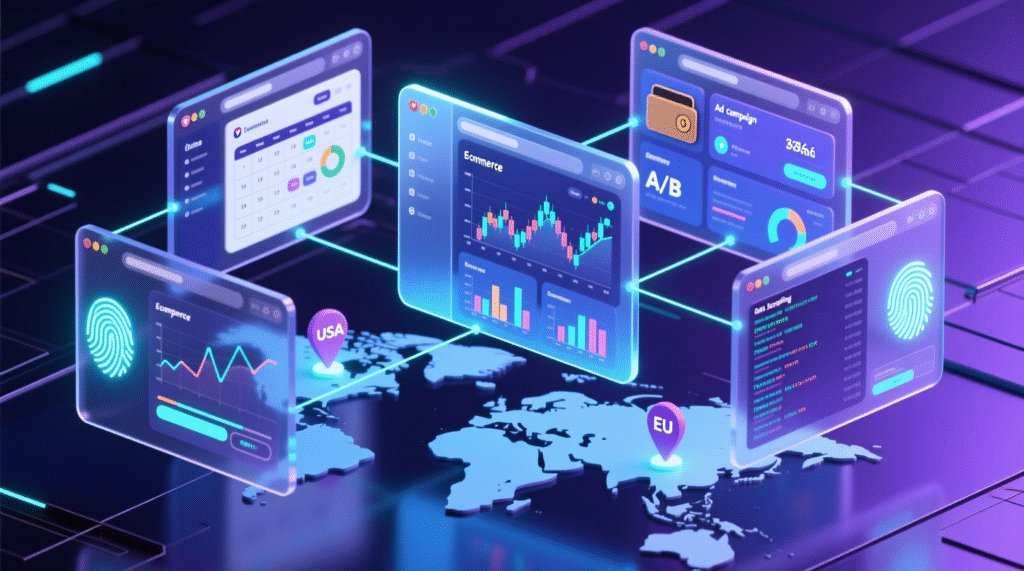
Main areas of use:
- Social media agencies
- Affiliate marketing
- Online store management
- Dropshipping
- Advertising campaigns
- Web scraping
- Web application testing
- Cryptocurrency activities
1. Social media agencies
Are you familiar with the message “Suspicious login” on Instagram or Facebook?
Even regular users managing a couple of personal accounts face verification checks when changing devices or geolocations. Now imagine: your team of 12 manages 200+ client accounts. Every login from a new IP or device triggers an alarm in the platform, requiring confirmation from the account owner—making delegation nearly impossible.
Social networks strictly monitor digital identities. Therefore, stable and secure management of multiple accounts is not a luxury, but a necessity for any professional SMM agency.
How is this solved?
Anti-detection browsers create a separate profile for each account with a unique “fingerprint”—as if each account were owned by a real user. This allows you to:
- Manage dozens of accounts simultaneously
- Avoid bans and blocks
- Scale your work without risks
- Maintain the confidentiality of client data
- Work even in countries with social media restrictions (simply by changing your profile geolocation)
The advantages are clear:
- Unlimited number of profiles
- Uninterrupted work from any device
- Bulk account creation (“farming”)
- Secure task distribution within a team
- Increased privacy and control
2. Affiliate Marketing
Imagine: you’re looking for Nike sneakers, stumble upon a website with an Amazon affiliate link, and make a purchase. The website owner receives a commission—not for the sale of the product, but for the traffic it brings in. This is affiliate marketing (or traffic arbitrage), and it’s completely legal in the US and EU.
On paper, it’s simple. But in practice, scaling a business without multi-accounting tools is nearly impossible. To increase reach, you need:
- Multiple accounts for running different campaigns
- The ability to promote links without the risk of being blocked
- Different digital identities for testing hypotheses
An anti-detection browser is a must-have here. It allows you to safely manage your ads.Manage multiple profiles, avoid detection, and significantly increase the effectiveness of affiliate strategies.
3. E-Commerce Store Management
The pandemic has accelerated the growth of e-commerce, and many sellers have faced new challenges. Platforms like Amazon, Etsy, and Shopify prohibit selling unrelated product categories in a single store. Launching parallel stores is a logical solution, but platforms are actively combating this approach.
How to bypass restrictions?
Anti-detection browsers allow you to “fly under the radar”: each store operates with a unique browser fingerprint, mimicking the behavior of different users. This:
- Protects against blocking
- Allows product range diversification
- Increases reach without additional investment
In a highly competitive environment, this isn’t a gimmick, but a strategic necessity.
4. Dropshipping
Dropshippers don’t keep products in stock—they forward orders directly from suppliers. This reduces costs, but creates other problems:
- Fierce competition
- Platform limitations
- Volatile prices and product availability
The solution is multiple independent stores, each with its own profile. Anti-detection browsers make this possible.
They also help:
- Analyze competitors through web scraping
- Compare prices in different regions (by changing geolocation)
- Find more profitable suppliers in China, Korea, and other countries
Without anonymity and a change of digital identity, such tasks are extremely difficult.
5. Advertising Management
Launching ads in Facebook Ads Manager is easy. But scaling them is a whole other matter. One account won’t allow:
- Test dozens of hypotheses simultaneously
- Promote different products without overlapping
- Avoid blocking during aggressive campaigns
Therefore, professionals use account farming—the mass creation of profiles that are “warmed up”: they imitate the behavior of real users (viewing content, uploading photos, interacting with services).
Anti-detection browsers + proxies = the ideal tool for securely registering and managing such accounts.
Ethical considerations:
Yes, account farming can raise questions. But in practice, it is widespread—from small businesses to large corporations. The main thing is to comply with platform rules and not break laws. The technology itself is neutral: everything depends on how it is used.
6. Web Scraping
Imagine: you need to collect 3,000 rows of data from different websites, structure it, and analyze it. Manually, it’s impossible. This is where automated data collection (scraping) comes in.
Scraping is legal if the data is public. Example: airline ticket aggregators that compare prices between partners.
Where does an anti-detector come in handy?
Websites block bots using browser fingerprints. Anti-detector profiles appear to be real users, which:
- Reduces the number of captchas
- Increases data collection stability
- Allows you to quickly replace a blocked profile
Furthermore, virtual profiles save resources—there’s no need to maintain hundreds of physical devices.
Useful applications of scraping:
- Price and competitor analysis
- Lead generation
- Market and sentiment research
- SEO monitoring
- Sports betting and real estate
7. Web Testing
Testers have to test websites for different:
- Screen resolutions
- Operating systems
- Geolocations
- Browser versions
Previously, this required dozens of devices or complex emulators. Today, a single anti-detector browser is enough.
You create a profile with the necessary parameters and test instantly. This saves time, money, and stress.
A plus is the ability to automate routine tasks and speed up QA processes.
8. Cryptocurrency Enthusiasts
The crypto market is constantly evolving. Participating in IDOs, NFT drops, and airdrops are real ways to obtain assets at a low price. But the conditions are strict:
- You need to be on the whitelist
- Complete social tasks
- Pass KYC verification
- Make it at the right moment
And the competition is thousands of participants per lot.
The solution? Multi-accounting.
But crypto platforms are actively combating this through fingerprint analysis. An anti-detector is essential here. It allows you to:
- Create multiple independent accounts
- Complete KYC once per profile
- Increase your chances of participating in drops
- Protect your personal data
For example, the NFT token Cryptopunk #5822 was sold for $23.7 million in 2022. And the record belongs to the Merge by Pak collection – $91.8 million in 2021. The possibilities are enormous – the main thing is to have the right Correct tools.
Conclusion: The future belongs to multiple accounts
The scenarios listed above are just the tip of the iceberg. These areas are rapidly developing, and anti-detection browsers are becoming the standard in digital business.
The internet isn’t getting any safer—on the contrary, surveillance systems are getting smarter. Therefore, technologies that help preserve privacy and manage digital identity will be in demand for many years to come.
If you work in one of these areas, keep up with the trends.
Try the anti-detector browser today.