
Today, Bitcoin no longer needs an introduction. This cryptocurrency has become a separate asset class that many use to preserve capital and protect their purchasing power in conditions of unstable global economy.
There are constant debates around Bitcoin: some consider it a revolutionary asset of the future, others—a dangerous and useless scheme. Optimists are often early investors who literally “put money where their mouth is.” Pessimists point to the main feature of the crypto market—high volatility, and call Bitcoin a financial pyramid.
Although I agree that Bitcoin is indeed very volatile, this doesn’t make it a pyramid. Any active trading on a free market where there’s no regulation inevitably leads to sharp price fluctuations.
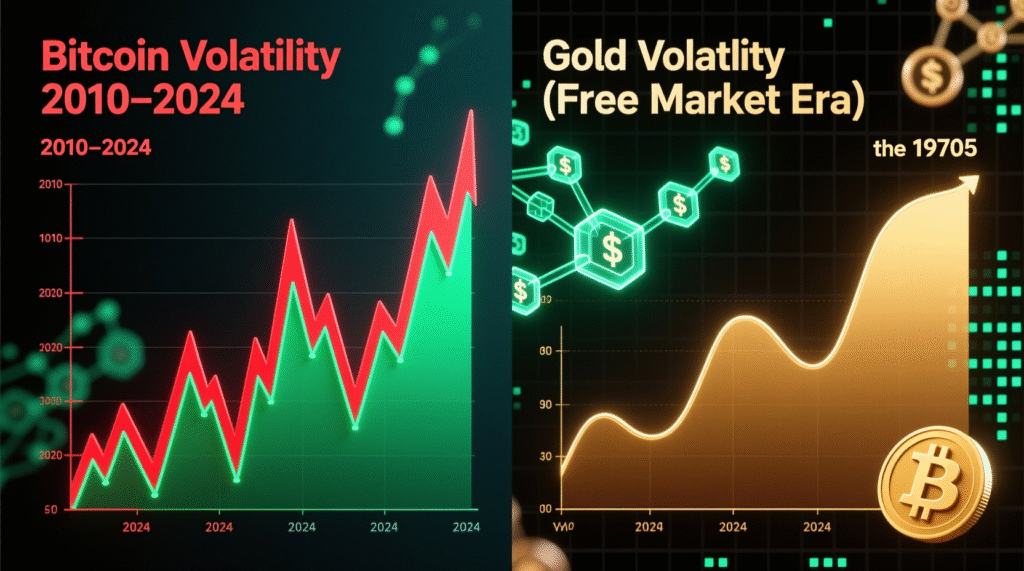
For clarity, we can recall gold. In the early 1970s, when gold began trading on a free market, its price also experienced serious jumps. The chart from that period remarkably resembles Bitcoin’s early history.
What is Volatility?
In financial terminology, volatility (denoted by the symbol σ) is a measure of how quickly and strongly an asset’s price changes over a certain period. It’s calculated through the standard deviation of annual returns. Simply put, volatility shows how unpredictable or sharp price movements can be.
In the world of cryptocurrencies, it’s the same: volatility is simply a way to measure how much Bitcoin’s or another cryptocurrency’s price fluctuates over time.
Example:
In the morning, Bitcoin cost $17,260, and by evening of the same day it fell to $15,000. Such sharp changes are manifestations of high volatility.
Bitcoin’s volatility chart from 2010 vividly demonstrates these jumps. Many call this “instability,” but it’s important to understand the context: cryptocurrencies, like gold in its time, trade on a free market where prices are formed exclusively under the influence of supply and demand, without government or regulator intervention.
What to Do with Such Volatility?
Until the crypto market reaches maturity and saturation (and when this will happen—no one knows), volatility will remain its integral feature. If you’re not ready for such swings, you shouldn’t invest in cryptocurrencies. Never invest more than you can afford to lose.