FOMO — fear of missing out…
Since Bitcoin broke through the $1000 mark in late December 2016, interest in cryptocurrencies has exploded.
If at the end of 2016 the total crypto market capitalization was $17 billion, by mid-2017 it grew to $110 billion—that’s growth of more than 500% in just six months.
Is this a bubble or the beginning of a new era of “Internet of Money”?
I’m convinced—this is reality.
Just as the internet decentralized information, blockchain now decentralizes money.
Bitcoin became the first step, but it has shortcomings—especially in terms of privacy and transaction speed.
It’s these limitations that gave birth to a new class of cryptocurrencies—anonymous digital money.
One of the most promising in this segment is Dash.
What is Dash?
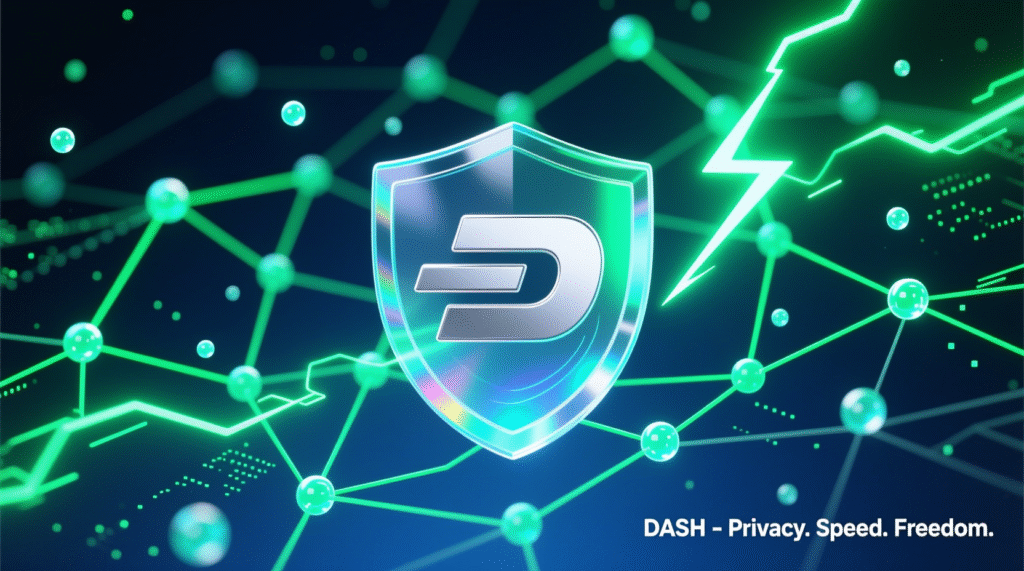
Dash is not a smart contract platform like Ethereum, but rather digital cash.
The project’s goal is to become as convenient and liquid a payment method as fiat currencies: dollar, euro, ruble, etc.
Dash is based on Bitcoin’s code but enhanced with important features:
- instant transactions,
- enhanced privacy,
- minimal fees.
Like Bitcoin, Dash is an open-source project with its own blockchain, wallets, and community. However, unlike BTC, fees in the Dash network are practically unnoticeable to users.
The development team focuses exclusively on Dash’s role as digital money, which gives the project focus and stability.
Dash Creation History
Dash was launched on January 18, 2014, by developer Evan Duffield.
Initially, the project was called XCoin, then in February 2014 became Darkcoin, and in March 2015 received its current name—Dash (from “Digital Cash”).
Evan saw Bitcoin’s potential back in 2010 but realized: Bitcoin doesn’t provide sufficient anonymity and speed.
Since making such changes to Bitcoin’s core was impossible, he decided to create his own cryptocurrency based on its code—thus Dash appeared.
Team and Emission
Dash is developed by a decentralized team of enthusiasts and professionals.
Maximum number of coins—18 million DASH, which coincides with Bitcoin’s limit.
At the time of writing (June 2017), about 7.4 million DASH were in circulation, and full emission will only be reached by 2300.
Block reward decreases annually by 7.1%, and block generation time—2.5 minutes, which is 4 times faster than Bitcoin.
Market Capitalization
In mid-2017, the price of one DASH was $204, and market capitalization—$1.5 billion.
Dash ranked 6th-7th place among all cryptocurrencies by capitalization.
Where to Buy Dash?
Through Instant Exchanges
One of the simplest ways is to exchange on Changelly.
For this you’ll need:
- A Dash wallet address where you want to receive coins,
- Any supported cryptocurrency (BTC, LTC, etc.).
The process is similar to buying other altcoins—simply select DASH from the list.
On Crypto Exchanges
Dash trades on leading exchanges:
- Binance: DASH/BTC, DASH/ETH
- Bittrex: DASH/BTC, DASH/ETH
- Gate.io: DASH/BTC, DASH/USDT
- Bitfinex: DASH/BTC, DASH/USD
- KuCoin: DASH/BTC, DASH/USDT, DASH/ETH
Important: Don’t store cryptocurrency long on exchanges. It’s risky. Better transfer funds to a personal wallet.
Dash Wallets
Mobile Wallets
Available for iOS and Android—convenient for everyday payments.
Desktop Wallets
- Dash Core — official full-featured client with InstantSend, PrivateSend, masternode management, and decentralized governance system support/
- Exodus — multi-currency wallet with built-in exchange through ShapeShift.
Hardware Wallets (recommended for storing large amounts)
- Ledger Nano S
- Trezor
- KeepKey
Paper Wallet
This is the cheapest way of “cold” storage. It contains private and public keys printed on paper. A detailed guide for creating a Dash paper wallet can be found in special articles.
Technologies Underlying Dash
Dash stands out with three key innovations:
- PrivateSend — ensures transaction anonymity by mixing funds through masternodes.
- InstantSend (formerly InstantX) — confirms transfers in seconds, not minutes.
- Masternodes — special network nodes that ensure the operation of the above functions and participate in project governance through a decentralized voting system.
Dash Price Growth
In February 2014, Dash traded at $0.02.
By mid-2017, its price grew by more than 1,000,000%.
Just from December 2016, growth exceeded 1500% (from $11 to $204).
At the 2017 peak, the price even briefly reached $1200 before correcting to $750—that’s +60% in a few days.
Despite competition from Monero, PIVX, and others, Dash remains one of the most practical, stable, and ready-to-use cryptocurrencies.