Want to generate income from cryptocurrencies? Then consider projects that regularly burn their tokens.
Burning is another unusual, yet effective way to make money in the world of digital assets.
If you’re already familiar with consensus algorithms such as Proof-of-Work (PoW) and Proof-of-Stake (PoS), you’ve probably also heard of Proof-of-Burn (PoB), the mechanism we’ll discuss next.
If you’re new to cryptocurrency, we recommend first understanding the basics of PoW and PoS—this will help you better understand why and how cryptocurrency is burned.
What is coin burning in cryptocurrencies?
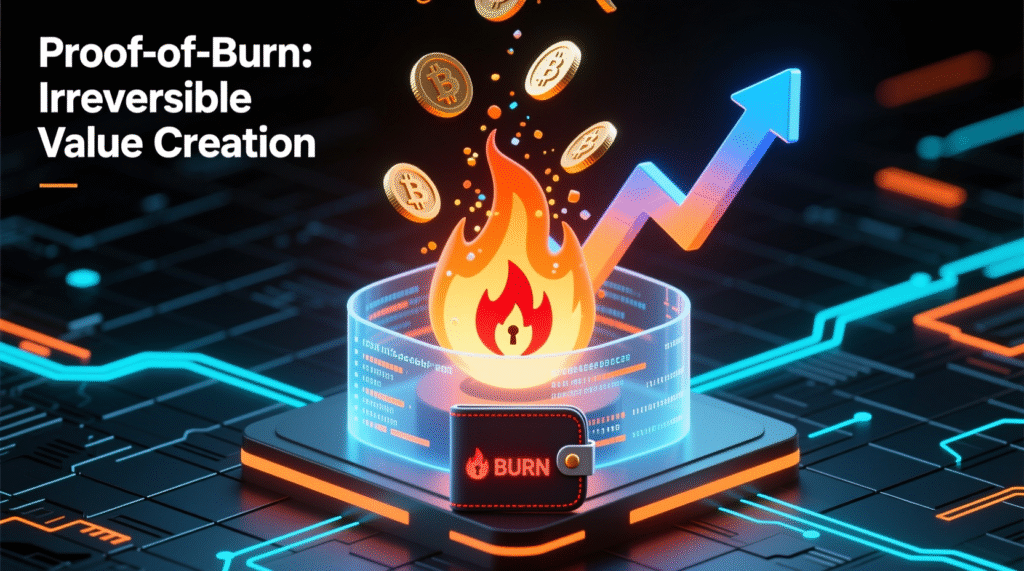
Coin burning is the process of sending a certain amount of tokens (either a native cryptocurrency or a third-party asset) to a special public address from which they cannot be spent because the private key to that address is inaccessible.
Such a transaction remains permanently recorded in the blockchain and can be verified by any user.
The main purposes of coin burning are:
- Creation of new tokens or cryptocurrencies (via Proof-of-Burn)
- Token Holder Rewards
- Destruction of unsold tokens after an ICO or token sale
Let’s look at each of these cases in more detail, but first, let’s understand how the Proof-of-Burn mechanism itself works.
Proof-of-Burn: An Alternative to PoW and PoS
Proof-of-Burn is a distributed consensus method alternative to PoW and PoS. It can also be used to launch a new cryptocurrency based on an existing one.
The idea is that participants (miners or validators) prove they’ve burned a certain amount of coins by sending them to an unspendable address. This requires a cost (like mining in PoW), but consumes no energy—the only “victim” is the burned coins themselves.
Today, most PoB projects burn cryptocurrencies mined through PoW (such as Bitcoin), so the ultimate source of scarcity is still related to the PoW “fuel”.
In some systems, burning grants mining rights to new blocks proportional to the number of coins burned. Think of it as a virtual mining rig created by destroying assets.
Why do people burn coins?
- To create new tokens or cryptocurrencies
Proof-of-Burn allows you to launch a new network without an ICO. Participants “invest” in the project by burning their existing coins and receive new tokens in exchange.
- To reward holders
In some jurisdictions (such as the US), direct dividend payments to token holders may violate financial regulations. Therefore, projects use token burns as an indirect method of rewarding token holders:
By reducing the overall supply, they create an economic shortage, which, according to the law of supply and demand, increases the price of each remaining token.
A prime example is Binance, which regularly (once per quarter) burns a portion of its BNB tokens, thereby increasing their value for investors.
- To destroy unsold tokens after the ICO
If there are unsold tokens left after a token sale, they are often burned to avoid an unfair advantage for the project team. After all, after a successful ICO, the token price typically rises, and if the team retains the unsold assets, they can sell them on the market at a large profit.
To maintain trust and transparency, such tokens are sent to a non-spendable address. For example, the Neblio team burned all unsold NEBL tokens, which was confirmed by a public transaction on the blockchain.
Conclusion
Coin burning is a flexible tool that can be used in a variety of scenarios, from launching new blockchain projects to protecting investor interests.
Many successful cryptocurrencies, including Binance Coin (BNB), use regular burns as part of their economic model.
Personally, I consider burning to be a positive practice and prefer to invest in assets that implement such a mechanism, as it creates a natural scarcity, which almost always leads to price growth in the long term.