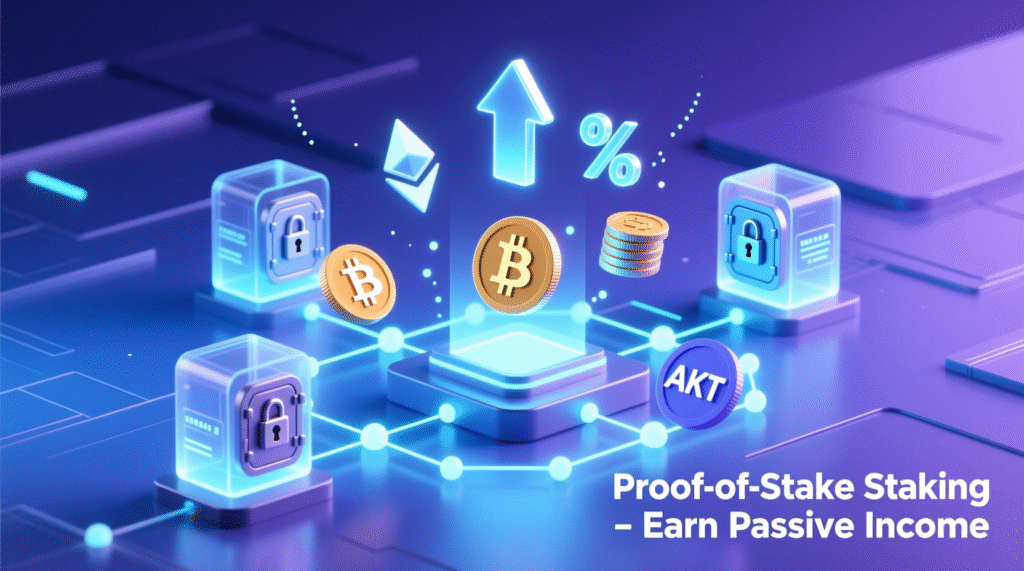
You’ve probably wondered: why should you pay attention to cryptocurrencies with a Proof-of-Stake (PoS) mechanism? What’s their advantage and how can you earn on them?
The thing is that PoS cryptocurrencies offer not only technical improvements compared to classic Proof-of-Work (PoW) systems but also real economic benefits for holders. Many of them allow earning passive income—simply by holding coins in a compatible wallet or running a masternode.
Thus, you simultaneously ensure network security and receive rewards for your assets—a kind of “crypto-dividends.”
What is Proof-of-Stake and Distributed Consensus?
Distributed consensus is a way in which participants in a decentralized network come to agreement about which transactions or blocks are valid. In Bitcoin, for example, this is achieved through mining (Proof-of-Work).
Proof-of-Stake is an alternative consensus algorithm that allows achieving the same goal with much lower energy consumption and lower operational costs. Instead of computational power, participants “stake” their coins to confirm transactions and receive rewards.
If you already own PoS assets—it’s time to learn how to start earning from staking. And if not—perhaps it’s worth considering such assets as a source of smart passive income.
Update from November 2022: Binance, the world’s largest crypto exchange, launched staking functionality
This is one of the simplest ways to start earning on PoS coins—especially for beginners. However, returns through exchanges are usually lower than with direct staking. But you get instant access to funds and don’t face technical setup complexities.
How to start staking on Binance:
- Log into your account (or register).
- Go to the Earn → Stake section.
- Choose a suitable coin, review the annual return and minimum amount for participation.
- Click Deposit and start earning passive income.
TOP 7 Profitable Proof-of-Stake Cryptocurrencies
1. Ethereum 2.0 (ETH) — 5–7% return
Ethereum is the most popular PoS platform, although it initially worked on PoW. As part of the Ethereum 2.0 update, the network completely transitioned to Proof-of-Stake to solve scalability and energy efficiency problems.
Since December 2020, the Beacon Chain has been launched, and ETH holders can stake their coins. There are three main ways:
- Run your own validator (requires 32 ETH and technical skills).
- Use centralized services (Binance, Coinbase, Kraken).
- Choose decentralized solutions, for example, Lido Finance.
It’s important to consider risks: if validator rules are violated, penalties (slashing) are possible, and centralized platforms store your funds on their balance, which carries risks of hacker attacks.
2. BNB — up to 30% return
BNB is the native token of the Binance exchange. It can be staked in several ways:
- Through BNB Vault on Binance (simple and convenient).
- Using the Trust Wallet mobile wallet (requires caution due to mobile device security).
BNB is available on Binance and Binance.US (for US residents).
3. Flow (FLOW)
Flow is a Layer-1 blockchain focused on games and NFTs. FLOW staking is possible through several official methods (details—in the video from the article author). The token can be purchased on major exchanges.
4. Akash Network (AKT) — up to 58% return!
Akash is a decentralized cloud platform based on Cosmos. Its native token AKT is used for network management and security. AKT staking offers one of the highest rates on the market.
For staking, it’s recommended to use the Keplr wallet. The token is available on several crypto exchanges.
5. Tezos (XTZ) — ~6.8% return
Tezos is one of the first PoS networks with built-in governance (on-chain governance). The staking process here is called “baking.”
The simplest way is to store XTZ on Binance, where staking happens automatically without fees. XTZ can also be bought on Coinbase (for the US).
6. Decentral Games ($DG) — up to 32% APY
$DG is an ERC-20 token of the Decentral Games ecosystem, focused on blockchain games and decentralized casino. The token is used for governance, liquidity, and community participation rewards. Maximum quantity—1 million tokens.
7. NOW Token — up to 25% annually
NOW is the token of the instant exchange ChangeNOW. Staking was launched in 2020 and offers a progressive reward system:
- 5% — after a week,
- 10% — after a month,
- 25% — after a year.
Minimum threshold—10 NOW, maximum—100,000 NOW per participant. Rewards are credited weekly. For staking, you can use Guarda Wallet or the Token Freezer tool.
Author’s Opinion: Is Staking Worth It in 2025?
After the collapse of Luna, FTT, and problems with Solana, it became clear: staking is not a risk-free way to earn. Possible losses include:
- Losses due to volatility,
- Funds locked for a long period,
- Risks of hacker attacks and smart contract vulnerabilities.
Nevertheless, with zero or negative rates in the traditional economy, crypto staking remains one of the most profitable passive income options—provided you take a conscious approach and diversify.