
Many of us hold (HODL) cryptocurrencies — but have you ever thought about freely spending them on goods and services without thinking about price? Most likely, no.
The reason is simple: most cryptocurrencies are extremely volatile — their value can fall or rise by 20–30% in just a few hours. This is related both to already incurred losses and expectations of future growth.
Moreover, when the market drops sharply, investors often don’t have a quick way to exit the position: withdrawing funds to fiat through exchanges can take time and doesn’t happen instantly.
This is where stablecoins come to help — stable digital assets created to solve these problems.
What Are Stablecoins?
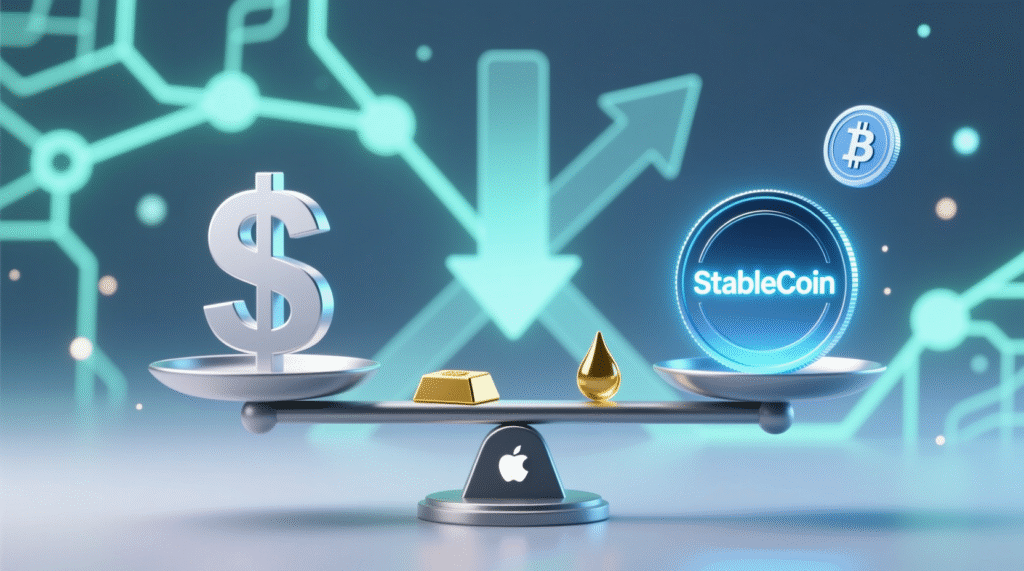
Stablecoins are a special type of cryptocurrency whose value is pegged to real assets, such as fiat currencies (USD, EUR, JPY, CNY), and sometimes even to gold or oil. Thanks to such pegging, their price remains relatively stable, unlike BTC or ETH, whose value constantly fluctuates.
Some stablecoins are backed by other cryptocurrencies, but this is not always the case.
Like other crypto assets, stablecoins work on blockchain — whether it’s their own network or tokens on existing platforms (for example, ERC-20). However, unlike regular cryptocurrencies, they strive for stability.
It’s important to understand: stablecoins are not connected to central banks or states. Their reliability depends on reserve transparency and regular audits confirming the presence of backing. At the same time, they are globally available and not controlled by specific jurisdictions — although entering and exiting the ecosystem (on/off-ramps) usually requires passing KYC verification.
Why Are Stablecoins Needed?
Imagine you’re a coffee shop owner, and a customer paid you $50 for coffee in Bitcoin. But the next day, BTC price dropped by 20%, and your $50 turned into $40. This is unpleasant.
Or vice versa: you’re a buyer who paid with cryptocurrency, and immediately after transaction confirmation, its price rose by 20%. Now you regret not waiting a minute and paying a smaller amount.
It’s precisely such situations that make regular cryptocurrencies inconvenient for everyday payments. Stablecoins, however, provide psychological peace: you know exactly that your $50 will remain $50 tomorrow.
Types of Stablecoins
There are three main categories of stablecoins:
- Fiat-Collateralized
Their value is backed by fiat currency reserves — for example, each USDC token is supposedly backed by one US dollar. - Crypto-Collateralized
Such stablecoins are supported by other crypto assets. However, due to the volatility of backing, this approach is risky and hasn’t yet passed serious market tests. - Non-Collateralized / Algorithmic
These stablecoins have no backing. Their stability is achieved through algorithms and smart contracts that automatically regulate token supply — increasing or reducing it depending on market price.
Pros and Cons of Stablecoins
Advantages:
- Stability in trading and payments
- Peace of mind in transactions
- Quick liquidity in market crisis conditions
- Protection from extreme volatility
Disadvantages:
- Risk of supply manipulation (for example, scandals around USDT)
- Possible absence of real backing
- High degree of centralization (often one issuer controls the entire emission)
- Historically, price could deviate by ±10% from the peg
- All types face the “oracle problem” — the difficulty of reliably obtaining external data in blockchain
Conclusion: Which Stablecoins Are Worth Considering?
Stablecoins are indeed useful — but only if they are truly stable and regularly undergo independent audits. Ideally — if such checks are partially decentralized to avoid situations like the one that arose with Tether (USDT).
Any stablecoin project should either implement a reliable governance mechanism or solve the oracle problem — otherwise its existence loses meaning.
Here are several well-known and actively used stablecoins:
- USDC
- BUSD
- Tether (USDT)
- TrueUSD (TUSD)
- MakerDAO (DAI)
- Basis (project closed, but mentioned in original)
- Havven (now Synthetix, HVN token)